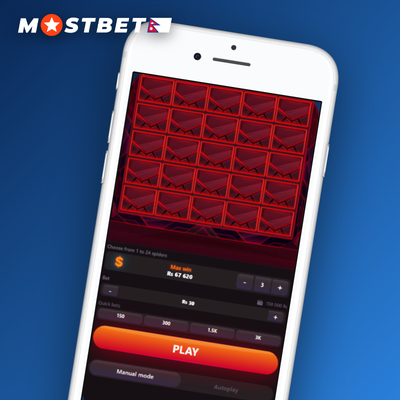
Mines Mostbet brings a sharp grid-based challenge to Nepalese players, built on a 5x5 board where every safe gem you uncover pushes your multiplier higher. The game runs at a 97% RTP, giving you a transparent edge over comparable instant-win formats. NPR deposits are supported, so you stay in your local currency from first bet to cashout. Pick your mine count, tap carefully, and lock in your multiplier whenever the moment feels right.
Welcome Bonus
125% match, up to 25,000
Use promo code BETBONUS125
What Mines is and how the grid works
Mines on Mostbet is a tile-based game played on a 5x5 grid, where you flip cells to uncover gems and grow a multiplier — one hidden mine ends the round instantly. After a quick mostbet login nepal, you can set your mine count, start revealing tiles, and cash out any time before hitting a mine.
RTP
97%
Minimum bet
NPR 10
Maximum bet
NPR 100,000
Maximum multiplier
10000x
Demo mode
Yes
Auto play
Yes
Mines keeps rounds short and decisions entirely in your hands — you set the mine count, reveal tiles at your own pace, and choose when to cash out before the multiplier resets. That combination of player-set risk and instant cash-out control makes it one of the most direct games on the platform. If you enjoy fast-paced crash-style titles, the aviator mostbet apk brings a similar thrill. Each round's outcome is determined the moment it begins, which leads naturally into the provably fair mechanics covered next.
Play Mines Free, No Deposit Needed
Demo mode lets you explore the grid, test your cashout timing, and learn the rules at zero cost.
Provably fair mechanics behind every round
Each round outcome is random, determined the moment you place your bet through a provably fair system that pairs a server seed with a client seed. Once those seeds are locked in, neither Mostbet nor you can alter where a mine lands on the grid. After the round, you can verify the result independently using the seed values — a transparency feature that makes Mines one of the most auditable games available. For broader guidance on managing your sessions, mostbet betting tips cover bankroll habits that pair well with this kind of verifiable play.
How to verify a round
Before the round starts, the server seed hash is displayed in your game panel — a cryptographic commitment to the outcome that is already fixed.
Change your client seed to any value you choose before revealing tiles, giving you direct input into the combined seed pair that shapes each mine placement.
Play the round and cash out or hit a mine — the result is now sealed.
After the round ends, the full server seed is revealed, allowing you to match it against the hash shown at the start and confirm nothing changed.
Run both seeds through any standard SHA-256 tool to independently reconstruct the provably fair outcome and verify every mine position was set before your first tile flip.
The provably fair system means every outcome is governed by verifiable mathematics, not chance or operator influence. Once you check the revealed server seed against the original hash, you can confirm independently that no tile result was altered. Each round outcome is random and set before you touch a single tile — no tool can predict where mines are placed, and no external app changes that reality. Even a mostbet cash agent or platform affiliate has zero visibility into upcoming mine positions. The math is open; the randomness is genuine.
Why seed verification matters
When you play on the 5x5 grid, you are trusting that the mine layout was fixed before you revealed your first tile — not adjusted in response to your choices. Seed verification gives you independent proof of exactly that. Before each round begins, the server commits to a hashed server seed that you can record. After the round ends and the server seed is revealed, you can run the same cryptographic calculation yourself and confirm the mine positions were locked in from the start. This is the core promise of a provably fair system: you never have to take the operator's word for it. Whether you uncover two tiles or fourteen, the underlying layout was already determined and cannot be rewritten retroactively. For players in Kathmandu or anywhere else, this transparency is a genuine safeguard — it shifts accountability away from trust and toward mathematics you can verify with any standard SHA-256 tool.
Smart strategies for Mines players
Every approach to Mines is really about shaping your risk level, not predicting where mines land. Conservative players keep the mine count low, accepting smaller multiplier jumps in exchange for more frequent safe tiles. A balanced setup of three to five mines raises the tension — and the reward — without pushing the odds to extremes. Whatever configuration you choose, bankroll management is what keeps you in the game: set a stake you are comfortable losing on any single round, and cash out before greed overrides discipline. No strategy changes the fact that each outcome is random.
Practical Mines playing tips
Try demo mode before staking real money — the free practice version lets you test configurations without any financial exposure.
Keep each stake between 1% and 2% of your session bankroll. With a minimum bet of NPR 10, even a modest starting balance gives you plenty of rounds to find your rhythm.
Set a target multiplier before you start revealing tiles and cash out the moment you hit it — discipline here is the core of sound bankroll management.
Never chase losses by increasing your stake after a bad round. Each outcome is independent, so a larger bet does not improve your odds of hitting a safe tile.
Use auto play to lock in a consistent stake size across multiple rounds, removing the temptation to adjust bets on impulse.
Every round of Mines is resolved by a random number generator, so no pattern, calculator tool, or third-party app can tell you where the mines are placed. Discipline and a clear exit point matter far more than any system. With that foundation in place, the next step is understanding how your choice of mine count shapes the risk and reward of every round.
Balancing risk and reward
Your mine count is the single dial that controls the risk level of every round. Set it to 2 or 3 and you have a wide field of safe tiles to reveal — the multiplier climbs slowly, but you can stay in the round longer and cash out at a modest gain before danger closes in. Push the count up to 10 or beyond and the board becomes far more dangerous: each reveal carries a much higher chance of hitting a mine, but the multiplier accelerates sharply with every gem you uncover. That compressed variance is what draws players who are comfortable with shorter, higher-stakes rounds.
Neither approach is inherently better. Low mine counts suit a patient, session-long style where you accumulate smaller wins across many rounds. High mine counts suit those who accept frequent busts in exchange for steep multiplier jumps when a run does go deep. The practical middle ground — somewhere in the 3 to 5 mine range — balances a manageable hit rate against multiplier growth that still feels meaningful. Wherever you land on that spectrum, decide your cash-out target before you start revealing tiles, not in the heat of the moment. The section that follows breaks down exactly how each mine count shifts the maths of every decision you make.
Start Mines With a Low Mine Count
Pick 1–3 mines on your first round to keep risk low and learn how the grid pays out.
Choosing your risk level and mine count
You can set anywhere from 1 to 24 mines on the grid, and that single choice drives every other variable in the round. A low mine count keeps tile probability high, so each reveal is more likely to be safe — but the multiplier climbs slowly. Push the risk level upward and variance rises sharply: fewer safe tiles remain, hit probability drops, yet the multiplier accelerates toward the 10000x ceiling far faster. Understanding this trade-off is the foundation of every decision you make before and during a round.
Step-by-step risk setup
1
Set your session bankroll
Decide the total amount you are willing to stake this session before you open the game — solid bankroll management starts here.
2
Pick a target multiplier
Choose the multiplier you want to reach in a round, keeping it realistic relative to your risk tolerance.
3
Match mine count to that target
Select a mine count that makes your target multiplier reachable in a manageable number of tile reveals.
4
Test your setup in demo mode
Demo mode is available on Mostbet, so run several rounds with virtual funds before committing real stakes.
Each risk level serves a different playing style. Low-mine setups keep variance minimal, making them well suited to steady, longer sessions where preserving your bankroll matters most. Mid-range configurations — typically three to five mines — balance risk level with meaningful multiplier growth without exposing you to extreme swings. High-mine setups push variance to its peak, offering a path toward the 10000x multiplier ceiling but demanding patience and a tolerance for frequent early exits. The table below maps each approach at a glance.
Three common risk profiles
Mostbet Mines — Play It Safe
With just one to three mines on the grid, consecutive safe reveals come frequently, keeping variance low and multiplier growth steady but modest.
Mostbet Mines — Balanced Approach
A mid-range mine count lifts the multiplier noticeably with each reveal while still leaving enough safe tiles for a meaningful run before cashing out.
Mostbet Mines — High Risk Rewards
High mine counts push variance to its ceiling — the multiplier spikes fast, but consecutive safe reveals become rare, so rounds end quickly.
Playing Mines step by step
Playing mines mostbet is straightforward once you understand the flow. Set your stake — anything from NPR 10 up to NPR 100,000 — choose how many mines to hide across the 5x5 grid, then start revealing tiles one by one. Each gem you uncover pushes the multiplier higher. The moment you feel comfortable with your profit, hit cash out before a mine ends the round.
Round settings at a glance
Bet range
NPR 10 – NPR 100,000
Mine count
1 to 24 mines per round
Play mode
Manual mode or auto play
Cash out
Available at any point after the first gem reveal
Demo mode
Yes — practice rounds available at no cost
Each round follows a simple rhythm. You set your stake, choose how many mines to place on the grid, then begin revealing tiles one by one. Every gem you uncover pushes the multiplier higher. The moment you feel the risk is outweighing the reward, hit cash out to lock in your winnings — or keep going for a bigger return. Touch a mine and the round ends with no payout. The steps below walk you through the full process.
Deciding when to cash out
Before you click the first tile, decide on a target multiplier and commit to it. Picking a number in advance — say, 3x or 5x — removes the temptation to push for just one more reveal once you are already deep into a round. Discipline at this stage matters more than any tile-selection approach.
Pay attention to the pace of consecutive safe reveals. The more gems you uncover in a single round, the fewer safe tiles remain on the grid, and the steeper the risk climbs with every additional click. Each new reveal does raise the multiplier, but it also narrows your margin for error. When the gap between your current multiplier and your pre-set target closes, that is your signal to act.
Hitting cash out locks your winnings immediately and ends the round on your terms. Waiting for one more tile might feel logical in the moment, but the odds shift against you with every safe cell already gone. Treat the cash-out button as the goal, not a fallback — reaching it means you played the round exactly as planned.
Mines FAQ for Mostbet Nepal players
Do tile patterns help you choose safe squares?
No. Each round in Mines is independently randomised, so no visual pattern from a previous game carries over. The provably fair system ensures mine positions are set before you touch the grid.
Can a calculator or predictor tool show where mines are?
No tool can predict where mines are placed — the seed-based RNG determines positions before each round begins, and no external software can read that data.
What is the RTP for Mines at Mostbet?
The return-to-player rate is 97%, which is competitive for a casual game of this type. This figure reflects long-run statistical return, not a per-session promise.
What is the maximum multiplier I can reach?
The maximum win multiplier in Mines is 10000x your stake. Reaching it requires revealing every gem on the board without hitting a single mine, which becomes increasingly unlikely as the mine count rises.
Can I try Mines for free before betting real money?
Yes, demo mode is available, letting you explore the grid mechanic and multiplier growth without risking funds. It is a practical way to test different mine counts before committing real stakes.
Set Your Mines, Cash Out Your Way
Choose your mine count, pick your tiles, and withdraw whenever you want — real bets start at NPR 10.